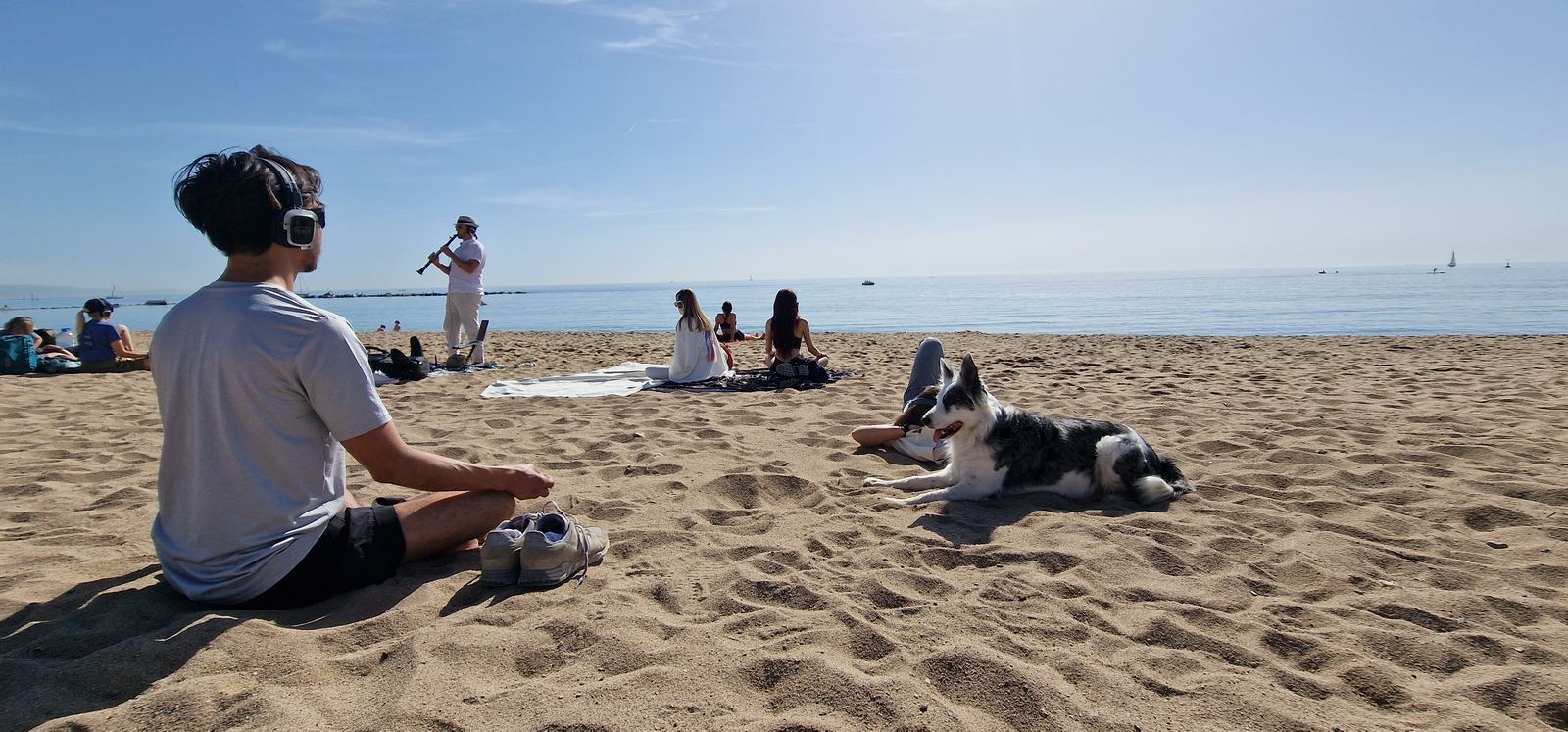
Guided meditation with headphones means every participant wears a wireless headset and hears the facilitator's voice, and any music or soundscape, directly in their ears. The voice feels as close as a one to one session even in a group of a hundred, and the space around stays quiet, so you can meditate on a rooftop, in a park or beside a busy street.
It is how we run many of our own wellness sessions, and the same kit is available to teachers, studios and event organisers through AURA Wellness. This guide covers what changes when you guide through headphones, and how to plan a session that works.
What changes when you run guided meditation with headphones?
Intimacy. Your voice stops being something that fills a room and becomes something that sits right beside each person.
In a normal room the back row hears echo and the front row hears you breathing. On headphones everyone gets the same voice at the same distance. That changes how people settle: they stop straining to hear, and attention moves inward faster. It also changes what you can do with silence, because a pause in the headset is a real pause, not a gap filled by traffic or the person next door.
How should you speak for the headset?
Quieter, slower and closer than you think, because the microphone does the work your voice used to do.
- Use your conversational voice, not your teaching voice. Projecting sounds harsh in the ear.
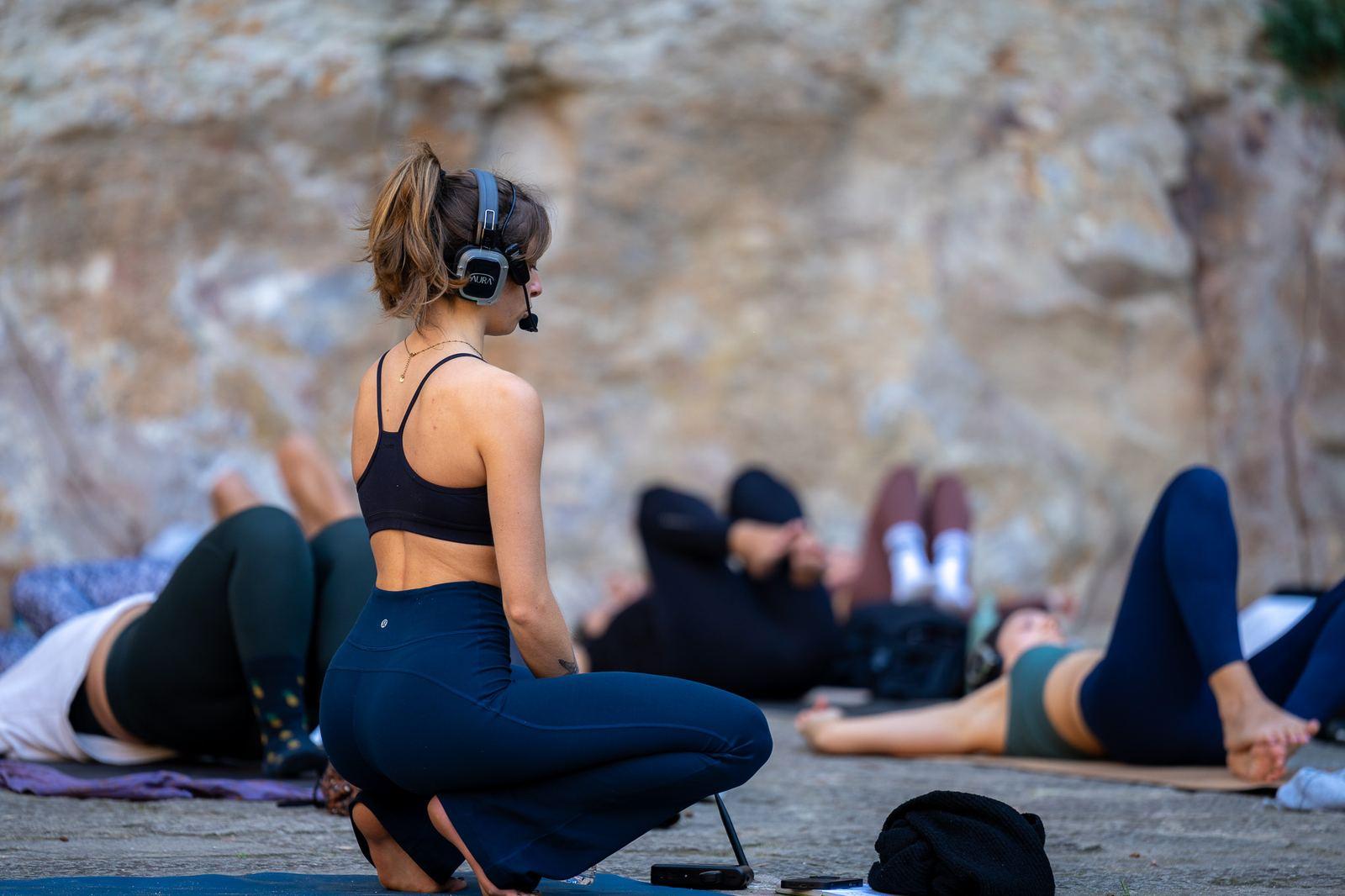
- Keep the microphone at a steady distance and slightly off to the side of your mouth, so breaths and soft consonants do not hit it directly.
- Leave longer pauses than feels natural. In a headset, ten seconds of quiet feels spacious rather than awkward.
- Step away from the microphone for anything not meant for the group, such as a word with an assistant.
- Rehearse once with a colleague wearing a headset at the far edge of the space, and ask what they actually hear.
How do you mix voice and soundscape?
Put the voice and the music on the same channel, with the music sitting clearly underneath.
A wireless microphone carries your voice into every headset on the same channel as the music. The soundscape comes from a phone or laptop connected to the transmitter by AUX (3.5 mm) or RCA cable, and some transmitters also take Bluetooth from a phone. Set the music level at the source, then speak over it on a test headset. If you have to raise your voice to be clear, the music is too loud.
For a live sound bath, a microphone placed close to the bowls or gong, run through a small mixer together with your voice, lets the instruments reach every headset too. Many facilitators keep it simple instead: a recorded soundscape plus a live voice.
Which practices work well on headphones?
Anything led by voice, and anything where sound itself is the practice.
- Guided meditation and body scans, where the closeness of the voice helps people stay with the instructions.
- Breathwork, where clear counts and timing matter and the group can follow without watching you.
- Sound journeys and sound baths, recorded or captured live.
- Walking meditation in a park or garden, with the voice following the group as it moves.
- Sunrise and sunset sessions, where the setting is half the experience and a speaker would wake the neighbourhood.
Coaches often borrow these ideas for the end of a workout. Our guide to silent fitness classes shows how a guided cool down fits in, and our earlier post on silent yoga and wellness events covers movement classes.
How can you use more than one channel?
Use channels to give people a choice of experience inside one shared space.
- Voice and music on one channel, music only on another, for regulars who prefer to sit without guidance.
- Two facilitators in two languages, one language per channel, in the same room.
- Two journeys at once, for example an energising breathwork session and a gentle relaxation, with people choosing as they arrive.
Each channel needs its own transmitter, and you can run up to three at once. A colour coded light on each headset shows the channel, so you can see at a glance who is where. Our guide to silent disco channels explains the switching in detail.
Where can you host a session?
Wherever the setting helps the practice, including places that would never accept a speaker.
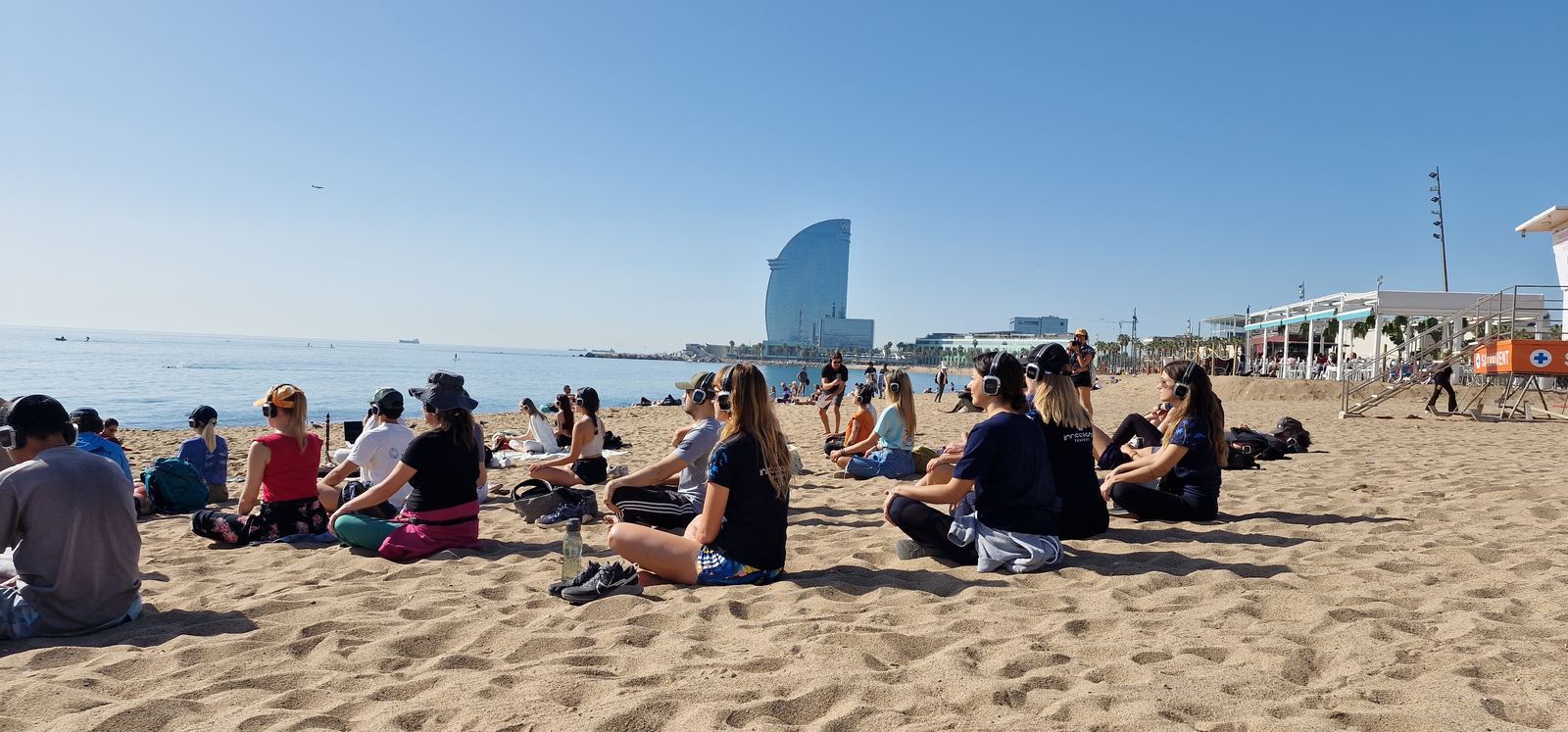
Rooftops at sunrise, beaches, parks, gardens, hotel terraces, galleries and office spaces all work. Outdoors, the headsets reach up to about 500 m from the transmitter with a clear line of sight, which is far more than a meditation circle needs. Headphones remove amplified sound, but check the venue's or council's rules on group activities in public space, and remember that early mornings can be cold for people lying still.
What does a 60 minute session look like?
- Minus 30 minutes: set out mats, power on the transmitter, then the headphones, set them to your channel, and test voice and music.
- Arrival: hand out headsets, show the volume control, and play quiet music so people settle as they come in.
- Minutes 0 to 10: welcome and a short breathing practice to bring the group into the headsets.
- Minutes 10 to 45: the main guided practice, with long pauses and the soundscape carrying the silences.
- Minutes 45 to 55: slow return, voice gradually louder, music fading.
- Minutes 55 to 60: invite people to remove the headsets in their own time, then collect them into the charging cases.
Full setup takes about 15 minutes, and each headset runs for about 8 hours on a charge, so a morning and an evening session fit on one charge. There is no minimum order and spare headsets are always included: request a quote with your session dates and group size and we reply with a price. New to the idea of headphone events in general? Our explainer on what a silent disco is gives you the background.
Frequently asked questions
Can you lie down while wearing the headphones?
Yes. Most people meditate seated or lying down with them on. A cushion or folded blanket under the head makes lying down more comfortable.
Do guided meditation headphones need an app or WiFi?
No. They work on radio frequency, not Bluetooth or WiFi, so participants do not need their phones at all, which helps the session too.
How many people can join one guided meditation?
Any number of headsets can listen to one transmitter, so the limit is your space, not the kit. There is no minimum order either.
Can I guide a session in two languages at once?
Yes. Run one facilitator per language on separate channels, each with their own microphone and transmitter, and participants choose their language on the headset.