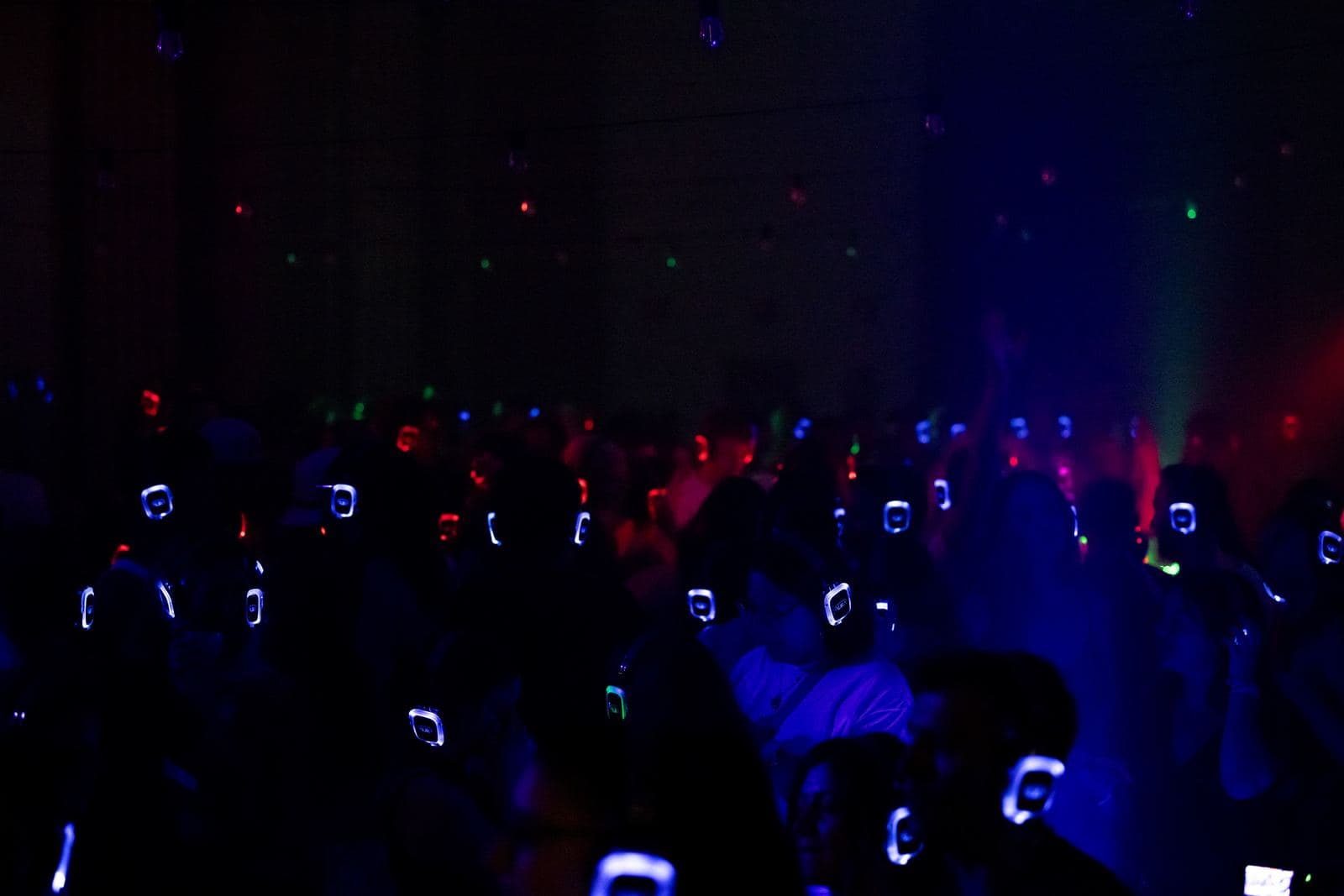
For events, the answer to RF vs Bluetooth headphones is radio frequency (RF), because one RF transmitter can broadcast to any number of headsets at once, with no pairing, no app and no internet. Bluetooth is built for one device talking to one other device at close range, which is perfect in your pocket and impractical for a crowd. That is the whole difference in two sentences.
Below we go through the reasons in plain language, so you can judge any headphone system, ours included. If you want to see the full chain from source to ear first, read how our headphone system works.
How does RF broadcast work?
An RF transmitter sends audio out on a radio channel, and every headset tuned to that channel receives it, much like a radio station and the radios listening to it.
The transmitter does not know or care how many headsets are listening. Twenty or several hundred, the signal is the same. That is why one transmitter per channel is enough, and why you can run up to three channels side by side with three transmitters. If the idea of channels is new to you, our guide to silent disco channels explains how guests switch between them.

Why not just use Bluetooth headphones?
Because Bluetooth is designed around pairing, and pairing does not scale to a crowd. Think about what it would take to connect a hundred guests' headphones, one by one, to a single DJ.
- Pairing: each Bluetooth headset links to a specific source. At an event that means hundreds of individual connections to set up and keep alive.
- Distance: Bluetooth is meant for short distances, like a phone and the earbuds of the person holding it. Dancefloors, gardens and walking tours are much bigger than that.
- Delay: Bluetooth audio usually arrives with a small delay that varies between devices. On your own it does not matter; in a crowd, people would hear the drop at slightly different moments.
- Crowded airwaves: a venue full of phones, watches and earbuds is already busy with Bluetooth traffic.
None of this makes Bluetooth bad. It is excellent at what it was built for. It is simply the wrong tool for sending one sound to many people at the same moment.
Why not WiFi or an app on guests' phones?
Because then your event depends on the venue's internet, on every guest's phone and on every phone's battery. That is a lot of things that can fail at once.
App based systems ask guests to download something, connect to a network, bring their own earphones and keep their screen awake. Busy networks can struggle, notifications interrupt the music, and a guest with a flat phone is out of the party. Dedicated RF headsets avoid all of it. Guests switch one on and they hear the music, which is exactly how it should feel.
What range can you expect from RF headphones?
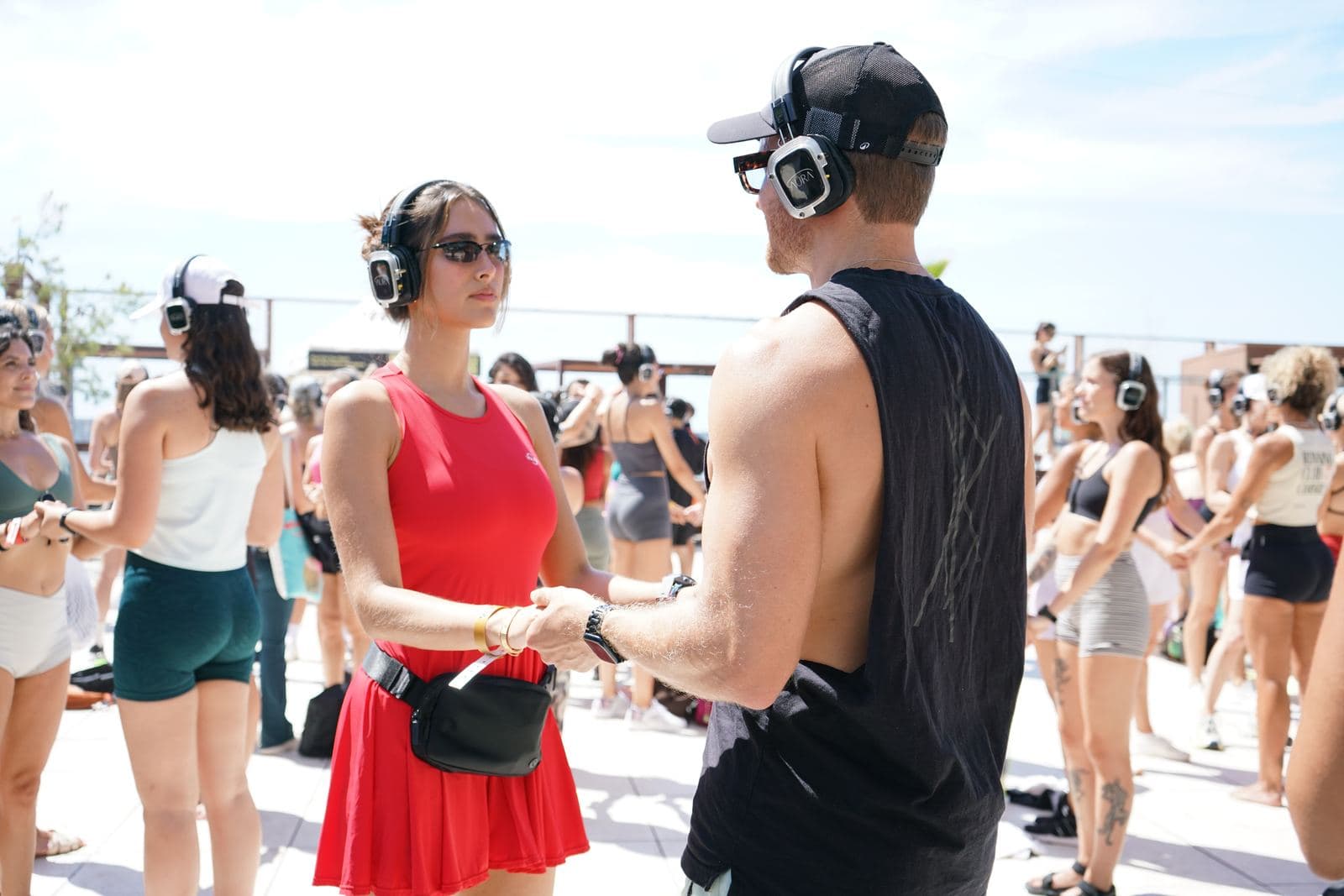
With AURA kit, up to 500 m outdoors with a clear line of sight between the transmitter and the headsets. Walls, floors and dense crowds reduce that, so indoors you plan for less.
In practice, this range covers a large dancefloor, a garden wedding, a beach party or a group following a guide through a park. For a deeper look at what reduces range and where to put the transmitter, read our guide to silent disco battery life and range.
Where does Bluetooth still fit in?
At the source end. Some transmitters accept Bluetooth input from a phone or laptop, which is a handy way to play a playlist without cables.
That is a single, short connection: one phone to one transmitter, sitting next to each other. The transmitter then broadcasts by RF to every headset. You get the convenience of Bluetooth where it shines and the reach of radio where it is needed. For DJs and live sound, a cable is still the steadier choice: AUX (3.5 mm) or RCA from the mixer or laptop into the transmitter. Our setup guide for silent disco headphones walks through each connection.
RF vs Bluetooth headphones for events at a glance
Here is the comparison for event use, side by side:
- Listeners: RF serves any number of headsets per transmitter; Bluetooth is built for one listener per connection.
- Setup: RF headsets just tune to a channel; Bluetooth needs each device paired.
- Phones and apps: RF needs neither; app systems need guests' phones, batteries and a network.
- Range: RF reaches up to 500 m outdoors in line of sight with AURA kit; Bluetooth is designed for short distances.
- Channels: RF lets guests switch between up to three channels with a button; Bluetooth has no shared channel idea.
- Best use of Bluetooth: sending a playlist from a phone into the transmitter.
What should you look for in event headphones?
Look for a system built for groups rather than individuals. Whether you rent or buy, check these points:
- RF broadcast, with no pairing and no app.
- Several channels, with a clear light showing which one each headset is on.
- Battery for a full event: AURA headsets give about 8 hours per charge.
- Volume control on every headset.
- Flexible inputs: AUX, RCA and, ideally, Bluetooth input on the transmitter.
- Charging cases and spare headsets, so a long event never runs short.
New to all of this? Our guide to what a silent disco is is the best place to start.
Frequently asked questions
Are silent disco headphones Bluetooth?
No. AURA headsets receive radio frequency directly from a transmitter. There is no pairing, no app and no WiFi involved.
Why is RF better than Bluetooth for events?
One RF transmitter broadcasts to any number of headsets at once over a longer range, while Bluetooth is designed for one device to one device at short distance.
Can I play music from my phone over Bluetooth?
Yes, on transmitters that accept Bluetooth input. Your phone connects to the transmitter, and the transmitter broadcasts by RF to every headset.
Do guests need their own phone or earphones?
No. Each guest gets a wireless headset that works on its own, so phones can stay in pockets.